IVF or ICSI? Understanding the Differences & Choosing What’s Best for You
Getting pregnant isn’t always easy. Numerous factors, including lifestyle, physical health, and genetics, can contribute to fertility problems. Fortunately, modern fertility treatments like IVF and ICSI can help you become pregnant even if you’re dealing with infertility. So, IVF or ICSI—which treatment should you choose? In this blog, we discuss the similarities and differences between the two treatments and how you can select the right one for you.
What is IVF?
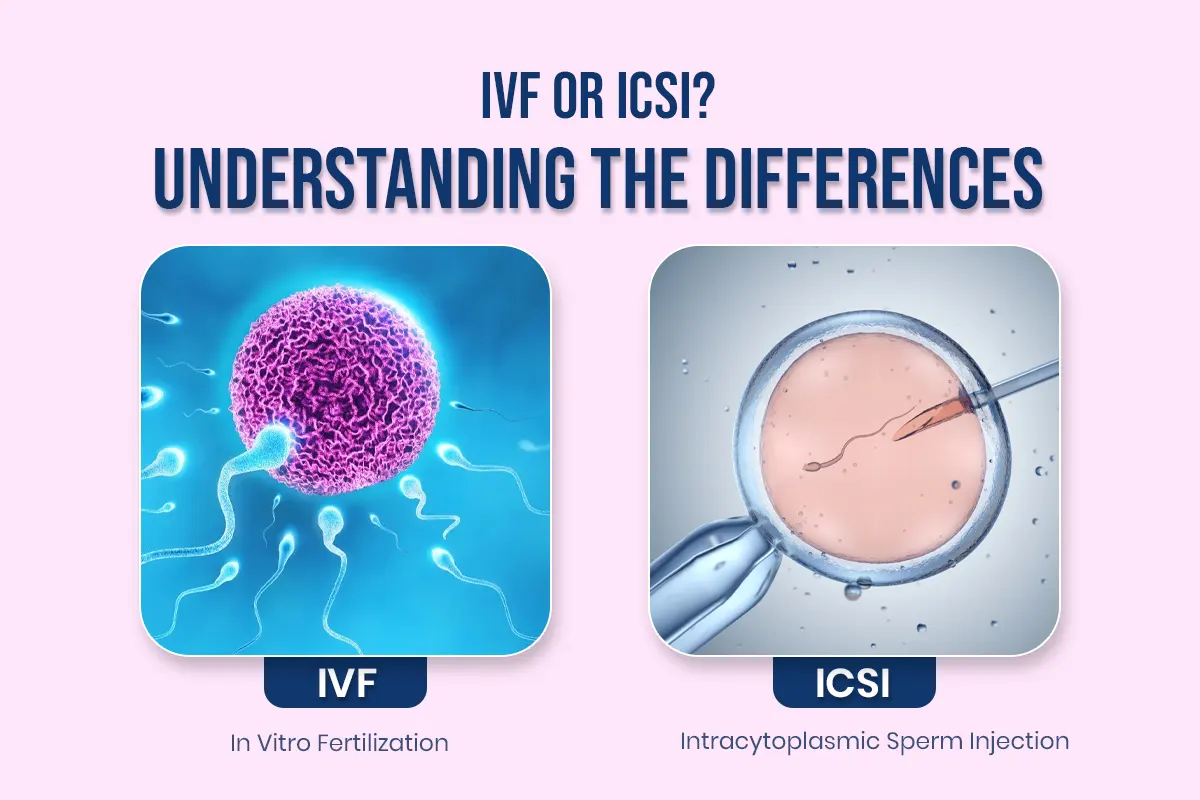
In vitro fertilization is a type of assisted reproductive technology (ART) that involves retrieving mature eggs from a woman’s ovaries and fertilizing them in a laboratory. Of the resulting embryos, the healthiest and most viable one is transferred to the patient’s uterus. There, it will continue to grow and develop into a fetus.
Here are some of the issues that can be treated with IVF:
- Unexplained infertility issues
- Polycystic ovary syndrome (PCOS)
- Endometriosis
- Blocked or damaged fallopian tubes
- Uterine cysts or fibroids
- Pregnancy with donated eggs
- Risk of passing on a genetic disease or disorder to offspring
What is ICSI?
ICSI stands for Intracytoplasmic Sperm Injection. In the ICSI process, all stages remain the same apart from the fertilization stage. Instead of mixing the eggs and sperm together in a petri dish, the embryologist injects a healthy, high-quality sperm directly into the cytoplasm of a single mature egg.
ICSI is extremely useful to treat male factor infertility. Here are some cases in which ICSI is recommended:
- Sperm are slow or unable to move (low motility)
- Low sperm count
- Blockages or obstructions
- Inability to ejaculate
- Abnormally shaped sperm
- Sperm with high DNA fragmentation
- Egg with thick zona pellucida (outer layer)
- Previous IVF failure
- Unsuccessful vasectomy reversal
There’s another lesser-known advantage to ICSI; it makes genetic testing on embryos possible. In the IVF process, the sperm and eggs are placed together in a petri dish. When this happens, multiple sperm crowd around a single egg and try to fertilize it. The remains of the unsuccessful sperm remain stuck to the outside of the developing embryo.
Conducting genetic testing on such an embryo also picks up on the DNA traces of the unsuccessful sperm cells. Doing ICSI ensures that only the genetic matter of the embryo is picked up during PGT testing. That’s why ICSI is mandatory if you want to opt for genetic testing.
IVF or ICSI: How are IVF and ICSI Different?
IVF and ICSI follow the same main process. The only difference is how the process of fertilization takes place. ICSI is better for treating male fertility, as it improves the fertilization rate. Embryologists inject the sperm directly into the egg’s cytoplasm, which improves its chances of successfully fertilizing. This helps more eggs develop into embryos even if there are issues with the sperm’s movement or shape.
On the other hand, IVF is better for couples with mild infertility issues or female infertility. In this scenario, the sperm don’t need extra help to fertilize the eggs, and so your IVF specialists will focus on trying to improve egg quality and embryo implantation.
Risks associated with IVF and ICSI
While both techniques are effective, IVF and ICSI may also carry the risk of certain complications:
- Sensitivity to fertility drugs (OHSS)
- Premature delivery
- Low birth weight
- Twins and high-order multiples
- C-section delivery
- A slight risk of birth defects
- Ectopic pregnancy
These risks are only slightly higher in ICSI and IVF than in natural conception. Both treatments carry a very low risk of complications overall, and most patients go on to have healthy pregnancies and babies.
Both IVF and ICSI can also cause emotional distress due to the uncertainty of a positive outcome. At Corion Fertility Clinic, we ensure that your treatment is as safe as possible to eliminate the risks associated with IVF or ICSI treatment.
Success Rates of IVF and ICSI
IVF has a higher success rate than treatments like intrauterine insemination. It can offer a success rate of 40 to 60% for women under 35. Additionally, the rate of success keeps increasing with each IVF attempt.
ICSI can help patients with male factor infertility achieve similar success rates as IVF by improving the fertilization rate. While it can definitely increase the fertilization rate, more research is needed to observe its impact on success rates compared to IVF.
Cost Of IVF and ICSI Treatment
In India, the cost of an IVF procedure can range from Rs 1,30,000 to over Rs 2,00,000. IVF and ICSI are quite similar, but ICSI is a slightly more specialized procedure. The step of injecting the sperm directly into the eggs also needs to be carried out by trained and experienced embryologists. Even a slight misstep can cause permanent damage to the delicate embryos. Because of this, ICSI usually costs at least 20 to 30% more than standard IVF treatment.
Key Differences Between IVF and ICSI
Here, we’ve listed down the differences between IVF and ICSI treatment.
Factors | In Vitro Fertilization | Intracytoplasmic Sperm Injection |
Type of Treatment | IVF is a type of assisted reproductive technology | ICSI is a type of IVF treatment |
Suitability | Best for female factor infertility and unexplained infertility | Best for male factor infertility and advanced maternal age |
Success Rate | High success rates of 40 to 60% | High success rates with improved fertilization rate (when treating male infertility) |
Cost | IVF costs lesser than ICSI treatment | ICSI is more expensive than standard IVF treatment |
Risk of Birth Defects | IVF carries a minor risk of birth defects, comparable to natural conception | ICSI has a slightly higher risk of birth defects and congenital deformities. The overall risk is still low |
IVF or ICSI: Which One Is Better For You?
Some clinics resort to ICSI as the default and do not offer standard IVF treatment. They may claim that doing so improves success rates. Note that as per research, ICSI does not increase chances of success if there is no male factor infertility.
So, which is the better choice for you, IVF or ICSI? In most cases, IVF treatment is good enough. It can treat various fertility issues and is even successful with unexplained infertility. On the other hand, ICSI is more effective in certain cases and is mainly used to treat male factor infertility. You might also choose ICSI if you want to get your embryos genetically tested.
Conclusion
IVF and ICSI are both useful fertility treatments that have helped thousands of couples achieve their dreams of parenthood. They can both be very effective when carried out by a team of experienced fertility specialists. IVF or ICSI—neither is inherently ‘better’ than the other. The best treatment for you will depend on your fertility issues, reproductive goals, and budget.
The choice between IVF and ICSI depends on your unique fertility challenges. Getting a comprehensive fertility screening will help us determine the treatment that will give you the best chance of success. To reduce risks and achieve success on your first attempt, you can also select additional treatments based on your fertility problems.
Still confused between IVF or ICSI treatment? At Corion Fertility Clinic, we combine advanced IVF and ICSI techniques with personalized care. Book a consultation to learn which treatment is right for you
Frequently Asked Questions:
Q. What are the disadvantages of ICSI?
A. ICSI has several disadvantages, such as a slightly increased risk of birth defects, potential for embryo damage during the injection process, and the possibility of genetic abnormalities being passed on. Modern advancements to the technique have minimized the risk of these disadvantages.
Q. Which is cheaper, IVF or ICSI?
A. ICSI is usually more expensive than IVF, as it requires more laboratory work and skilled embryologists.
Q. What is the difference between IVF and IUI?
A. IVF and IUI are assisted reproductive techniques. IUI places the sperm directly in the uterus, while in IVF the eggs are retrieved and fertilized in a lab. The resulting embryos are then transferred to the uterus.
Q. How is sperm selected during the ICSI process?
A. During ICSI treatment, embryologists choose the best sperm based on parameters like morphology (shape) and motility (movement). They may also use advanced sperm sorting techniques such as IMSI or PICSI.
Q. Why should I choose ICSI instead of IVF?
A. We recommend ICSI if male infertility is present or if you plan to do genetic testing on your embryos.
Copyright © 2026, Corion. All Rights Reserved.
Website is designed & developed by Phi Brands